Krystal Mwesiga Birungi still remembers watching her younger brother struggle with malaria.
He would have seizures while her mother tried to cool his body and keep him stable — doing what she could with limited resources. At the time, treatment wasn’t always within reach, and each illness came with uncertainty.
Those moments stayed with her. They shaped not only how she sees the disease, but also the work she has committed her life to today.
Now her most important goal is to help eliminate malaria in Uganda so that by the time her son, who is now seven, has a child, that child would not be affected or even be aware of Malaria.
In other countries, by the time a child turns five, they are expected to know how to read, count, and recognize shapes. In Uganda, the reality looks a little different.
Malaria remains one of the most significant public health challenges in Uganda. The country accounts for a substantial share of global malaria cases, with children under five among the most affected.
While prevention efforts and treatment access have improved over time, the disease continues to place pressure on families and health systems across the country.
According to the World Health Organisation, Malaria continues to be a leading cause of illness and death in Uganda. In 2023 alone, the country recorded over 16 million cases and 2793 deaths, most of them among children under five.
“When my son was five, I made a pretty long post about it on LinkedIn because I was so thrilled. [I said] he’s actually five years old, and I reflected on the fact that a lot of times, parents are pleased that their child is five and they can already read and spell. For me, it was ‘my child is five, and he’s alive’. I don’t care about the rest; he’s alive. We’ll figure out the reading, etc. When you know the malaria numbers, it’s a lot more real for you.”
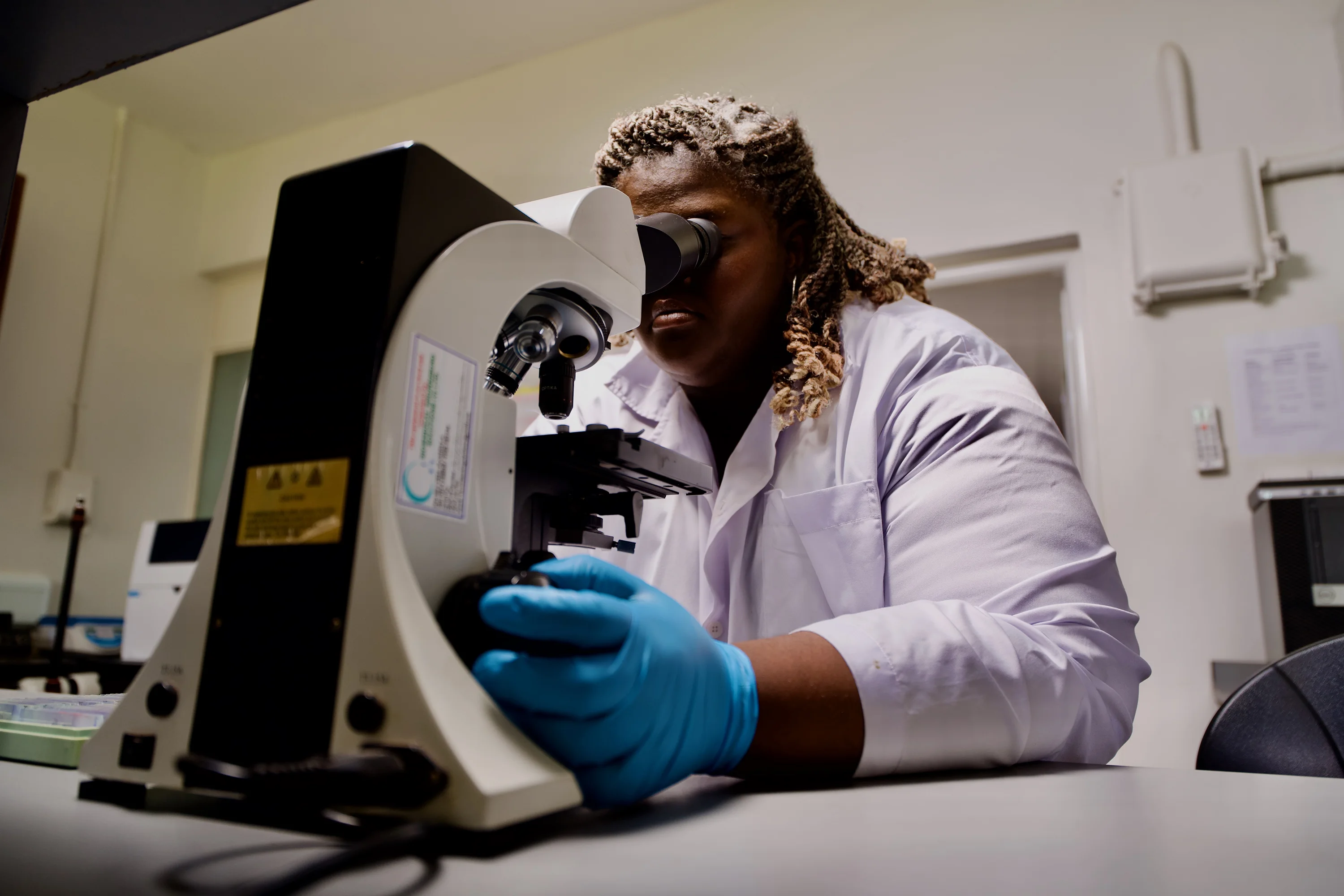 2026 Global Citizen Prize winner Krystal Birungi examines malaria samples in the lab as part of her work to strengthen diagnosis, treatment, and prevention efforts in Uganda. Image: Suhail Patel for Global Citizen
Meet Krystal, the Survivor
The Global Citizen Prize winner is a whizz at media interviews. All it takes is one question about her work, and she will read you chapter and verse on the importance of the fight against malaria, from the ground up, to the research, outreach, and advocacy work that comes with it.
She’s passionate about her advocacy work in Uganda because “my son lives here”.
Birungi was born and raised in Uganda, and by the time she was a teenager, she knew exactly what she wanted to do when she grew up. She might not have known exactly how, but she knew she wanted to roll up her sleeves and be part of the efforts to end malaria.
She was told that if she really wanted to help people, she should become a doctor. But Birungi wanted to know ‘the why’, and genetics could give her that answer.
She has a double major in Zoology and Botany from Makerere University and is an Entomologist and malaria advocate at Target Malaria, currently working as a Research and Outreach Advocate.
“Everyone has been affected by malaria here. If you throw a stone, you are more likely to hit someone who has had it than someone who hasn’t. If you are an adult, you’ve survived malaria. It’s almost universally the case here.”
She’s one of them. She had malaria as a child and then watched her little brother battle through more severe symptoms.
“I remember the helplessness of it. Of being in a situation where we could not afford mosquito nets, and we could barely afford the medication. Every time we fell sick, we didn’t know if we would survive,” she says.
It was not her own experiences with the disease that lit a fire in her.
“It was watching my younger brother struggle because he used to get seizures. My mother would struggle with that, just trying to wipe him down, keep him cool, and control the seizures. It was the helplessness of knowing there’s a medication for the disease, but you just can’t afford it, so all you can do is pray. That just struck me as deeply unfair.”
She was 14 when she first started seeing changes, as the world came together to fight malaria.
The global community distributed mosquito nets and free medication. “I saw that something can be done about malaria; it doesn’t have to be our life. Suddenly, my brother wasn’t having seizures every holiday when I saw him. You come home from school, and no one gets malaria for the whole season.”
Winning the Global Citizen Prize
Birungi does not take this win lightly. For years, she’s knocked on doors with one focus – everyone needs to play a role in ending malaria.
At the heart of her work is community engagement. She gives an example of malaria vaccines now available. There are four doses, and advocacy and community engagement are making sure that people understand what the vaccine is and trust it. To help them understand that it is worth taking the time to get their children vaccinated, even as it might lead to a loss of income for that day.
So winning the Global Citizen Prize is no small feat.
“It’s the acknowledgment that this work matters; someone looked at it and said those lives matter. The 600, 000 people who are affected by malaria every year, those lives matter,” she says.
“There is the fact that it gives me the opportunity to reach people who would have never heard about malaria and remind them why they need to care. It’s not just a number; these are our children, these are real people, and each life matters, but not if no one hears about it.
“All these children are dying, and no one knows. The Global Citizen is amazing because it means I get to make some noise for at least a year. No matter what it takes, people will hear me, and that sometimes makes all the difference,” Birungi says.
She’s going to use the opportunity to shine a light on the work that still needs to be done to completely eradicate malaria.
“It is a very big honour but also a big privilege to receive this award because it means I have a platform that so many don’t and in that time, it is my responsibility to make it count. Malaria is about humanity, about life, and it should be a Global Citizen issue,” she says.
“If, at the end of the year, I ask someone if they know why they should get the malaria vaccine, and they do, I will say it’s a year well spent.”
A Big Dreamer
Birungi can talk about malaria for hours. In fact, she does. She highlights the importance of collaboration, of working to ensure Africa creates the tools that help address malaria and making sure we never lose ground in the efforts to address malaria.
And she’s not putting the baton down until she reaches her goal.
“In my career span, I dream big. We are going to eliminate malaria. By the time I get to retirement age, there will be no malaria.”
She just turned 38.
“At the very least, by the time I get there, it will be a case of monitoring to ensure that we’ve really eliminated it,” she continues.
“There will be no local cases, and I truly believe that with the technology we have coming up, it is possible. That is why I am passionate about my project on genetically modified mosquitoes; that is why I am excited when people work on next-generation vaccines. Scientists are beginning to do something now; it’s up to us to make sure the work remains center stage.”