

“I want other women in this industry to see that there's space here for them too, even when the industry hasn't made it easy to find.”
- Vonna Vista
Vonna Vista is a queer artist-activist based in the Philippines who works as a communications and creative consultant for local and international nonprofit organizations. They are a visual storyteller whose practice sits at the intersection of art and advocacy. Vista uses discarded packaging material to confront a problem most of us throw away without a second thought.
“I've wanted to be an artist for as long as I can remember,” Vista shares. “I moved through writing, photography, film, always chasing the same thing: how to tell stories visually. The advocacy came later. It was the pandemic that pulled me into non-profit work, and once I was inside those spaces, I couldn't unsee what I saw. I started working with women's rights, human rights, and grassroots organizations, and then moved into environmental work. The two aren't as separate as they seem. The same systems that treat land and sea as things to extract from, use up, and discard are the ones that have always treated women's bodies and labor the same way. Plastic waste and gender inequality both stem from a culture of convenience that never asks who absorbs the cost. Working across both just made that connection impossible to ignore.”
Civic space in the Philippines is repressed, and that has impacted Vonna in a number of ways.
“As a queer woman in the Philippines, there is not enough space to begin with. Spaces for women [here] are already very few, but for queer women, there are almost none, so we had to make them for ourselves. The creative industry is still male-dominated, and even with years of experience behind me, I've lost contracts to male creative directors simply because clients trusted them more by default. In every space I've entered, I've had to prove my worth before anyone took the work seriously. That's its own quiet form of intimidation, not always loud or violent, but constant, and exhausting in the way it wears you down over time.”
For the Emerging Creatives Program, Vista has focused on plastic waste. The Philippines already generates roughly 1.7 million metric tons of post-consumer plastic waste every year, with Filipinos using more than 163 million plastic sachets, 48 million shopping bags, and 45 million thin-film bags in a single day. “Now layer e-commerce on top of that,” Vista adds.“The Philippine e-commerce market reached roughly US $28 billion in 2025 and continues growing at a double-digit rate, and protective materials like bubble wrap and air pillows made up over a third of global e-commerce plastic packaging use as recently as 2019, numbers that have only climbed since.”
Vista’s work treats plastic waste as an urgent crisis. “My work turns that overlooked, disposable material into something impossible to ignore.” That work sits between women's empowerment and environmental harm, particularly plastic waste. Vista grew up in a rural coastal community, watching plastic accumulate on shorelines long before they had the language to name it a crisis. Now they use art to call on governments and corporations to stop shifting the blame onto consumers, and to act with urgency to curb single-use plastics, not just bubble wrap.
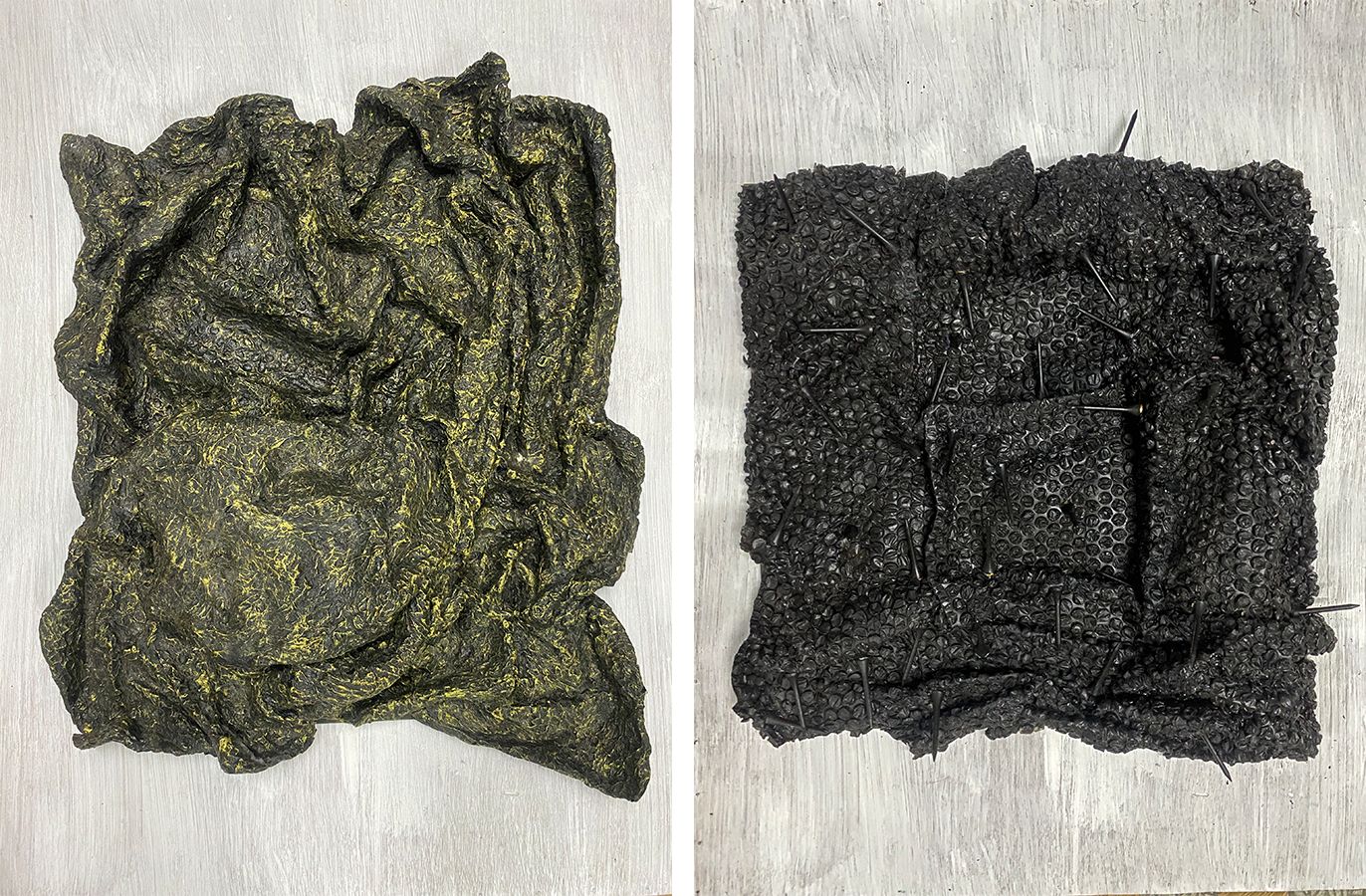
Vista describes the three pieces submitted for the program:
Piece 1 — "Thorned Convenience"
Bubble wrap shaped and scarred into a single black mass, pierced through with used golf tees like thorns. It's what convenience actually costs when you stop pretending the packaging disappears after you throw it away.
Piece 2 — "Gilded Sediment"
Folded and fossilized like a rock formation, streaked with gold the way we glamorize what we consume. It imagines plastic waste centuries from now, compressed into the earth's layers, still gleaming, long after we're gone.
Piece 3 — "Overprotected"
Bubble wrap exists for one purpose: to cushion what's fragile. Here, it's driven through with far more nails than any package needs, protection tipped into excess, the material meant to shield now built almost entirely out of things that wound.
For Vista, art is not only a tool for awareness but for real change. “I want people to feel the weight of using single-use plastics and packaging waste, to see it as something that outlives them, not something that vanishes at the curb. Every ‘add to cart’ click in the Philippines is quietly feeding a stream of single-use plastic that already totals 1.7 million metric tons a year, most of which has nowhere to go. But I don't want the weight to land on consumers alone. I want to use art to call on governments and big corporations to stop shifting the blame downward and act with urgency to curb single-use plastics, bubble wrap included. The people making individual choices shouldn't carry a crisis built by industrial-scale production. And I want other women in this industry to see that there's space here for them too, even when the industry hasn't made it easy to find.”
VISTA'S WORK

Global Citizen’s Emerging Creatives Program provides a platform for emerging creatives in the Global South that are highlighting the need for open civic space worldwide. Through their art, they call for change, shine a light on social injustices, and advocate for the advancement of the Global Goals.
MEET THE MENTOR
Rakaya Esime Fetuga
POET
South African-born Simphiwe Molefe, uses his photography to show the impacts of energy issues in the country. His collection of images titled, Impilo Iyaqhubeka, translates to mean “life goes on” in isiZulu and looks at how every day members of his community cope with South Africa’s ongoing power crisis.
In 2023, South Africa’s civic space rating was downgraded from “narrowed,” to “obstructed” — the third worst rating a country can have. That’s why Molefe believes creatives like himself have a role to play in highlighting the effects of the failure of basic services such as the power crisis in South Africa.