Zoneziwoh Mbondgulo-Wondieh is a Cameroonian feminist activist whose sights are set on advancing women’s rights. Her many titles include: award-winning humanitarian, storyteller, strategist, community mobiliser, campaigner, and opportunity-match-maker that connects women and girls to spaces, platforms, and networks that allow them to speak for themselves, claim their rights, and gain empowerment.
Currently Mbondgulo-Wondieh serves as the founder and Executive Director for Women for a Change (Wfac), a feminist advocacy and research organisation in Cameroon. In this role, she travels to communities across the country to carry out sexuality education, host empowerment trainings, and further the research and campaigning of her organisation.
In her own words, Mbondgulo-Wondieh shares how she connects women and girls to transformative opportunities that advance their gender and sexual and reproductive rights.
I had always been an unconscious activist…
… until my final years as an undergraduate in university where I gained my activist consciousness. This was in 2008, when out of curiosity, I decided to take a course on women, gender, and land rights. It was that course that triggered my consciousness and awareness on gender. I remember my first class like it was yesterday. I felt some sort of revival in my spirit, and since then there has been a quest for more knowledge. Inspired by what I learned in school, I volunteered for a couple of organisations locally and globally. Following which I founded the organisation Women for a Change in November 2009 — during 16 days of activism.
Because I did a bachelor’s in Environmental Sciences, I told myself it was important that I educate myself on gender. I then enrolled into multiple training programs.
All this training and classroom work — across six years at over four institutions — helped hone my gender analytical and theoretical skills in carrying out my feminist advocacy and research work. Thanks to this empowerment and under my leadership and initiative, Wfac is now an accredited observer with five UN agencies. It is also a member of the UN Women Major Groups, caucus and constituencies, leading advocacy actions across 11 central African countries and providing women leaders with the practical knowledge and skills needed in addressing gender-based violence through community resilience and feminist solidarity actions.
Right now, there is a lot of conversation around women and climate justice, but not enough structural change.
One of the biggest gaps is the disconnect between climate action and the realities of women and girls on the ground. Climate policies often ignore issues like access to healthcare, including SRHR, — even though climate issues directly affect these areas. That separation doesn’t reflect real life and it limits the effectiveness of any solution.
Another issue is access to resources such as climate finance — especially for grassroots communities and women’s groups. The conversations around climate finance often ignore the aspect of gender equality and intersecting barriers that women and grassroots communities face to access resources and opportunities. These barriers range from technical to infrastructural. Though the women and communities most affected by the climate crisis are the ones with climate-smart solutions and initiatives.
Established in 2009, Women for a Change is a subregional feminist advocacy, research, and awareness-raising organization.
Over the last 16 years, Wfac has continuously combined grassroots mobilisation, policy advocacy, and feminist movement-building to challenge patriarchal norms, taboos and stereotypes. We’ve done this by transforming minds towards believing in the rights of women and girls — especially around decision-making processes at all levels. Through our work, we have amplified the voices of 10,000 grassroots women leaders and marginalized groups to be heard by policy makers and critical decision-making spaces. We’ve also empowered over 50,0000 young people and women in Cameroon through our outreach activities, dialogues, workshops, and advocacy campaigns on sexual and reproductive health and rights (SRHR), climate justice, and gender equality.
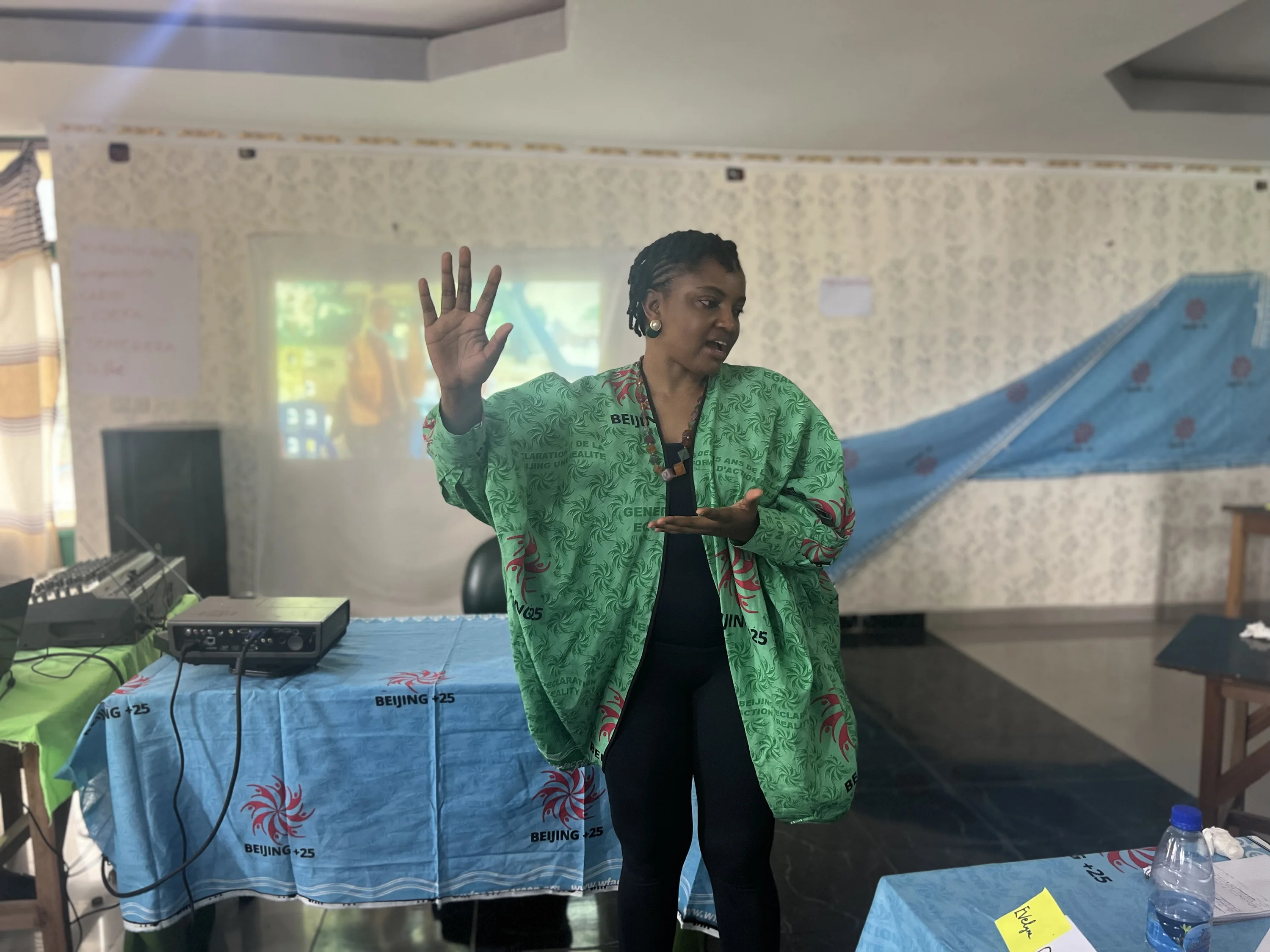 Dr Zoneziwoh Mbondgulo-Wondieh hosting advocacy training with female Members of Parliament and women human rights leaders in Bujumbura, Burundi.
One of the proudest moments in my work is seeing our in-school gShe program being considered as a non-graded course in some of the schools.
[The program promotes menstrual dignity, human rights, and gender equality through in-school and out-of-school activities — aimed at fostering leadership and safety for girls and young women in particular.]
With over a million adolescent girls reached over the last 13 years of the gShe program, all equipped to lead, self organise, and speak confidently in spaces where they were previously silenced helps in shaping our future activities.
Equally fulfilling has been the emergence of feminist movements, including an adolescent-led movement that continues to thrive despite repression — demonstrating that women’s collective voices can transform policy and practice.
Above all, one of the most rewarding moments is seeing some of those who I have mentored or coached regaining their confidence, trust, and independence and owning their journey.
Operating in Cameroon’s repressed civic space presents significant challenges.
Wfac has faced surveillance, harassment, and attempts to silence feminist voices; or being labelled in ways that try to undermine our legitimacy — particularly when advocating for SRHR and climate justice. Activists risk intimidation and violence, both online and offline, for challenging entrenched patriarchal norms. The lack of safe spaces for women’s rights defenders also constrains and limits our ability to effectively advocate for justice. Despite these barriers, Wfac continues to push forward, sustaining its mission through resilience and solidarity.
The Urgent Action Fund Africa has been a transformative partner to Women for a Change especially around our policy advocacy actions.
The timely and rapid response by UAF-Africa to requests has enabled Wfac to take advantage of policy opportunities to influence and shape public conversation. An example is the 2019 Beijing+25 Review Process, where governments were expected to submit national reports to UN Women on the progress made in implementing the Beijing Declaration and Platform for Action, 25 years after its adoption. Noting the absence of adolescent girls and young women in the national consultations held, Women for a Change, with support from UAF-Africa, hosted the 1st national adolescent girls advocacy leadership workshop and press conference on the Beijing25 National Review.
In 2023, when following heavy downpours, extreme flooding resulted in one of the most destructive catastrophes in Limbe, Cameroon, the state issued an emergency evaluation plan that was designed without the active participation and involvement of the women affected by the climate crisis. In a bid to respond to this emergency, UAF Africa supported the platform GenEgaliteECCAS, Solidarity Health Foundation and Wfac with a rapid response grant for a joint policy dialogues and advocacy held with local government and women from flood affected communities
Our women and young people are increasingly invited into conversations…
…but they are rarely in positions where they can influence decisions or grant access to attend these meetings in-person — beyond being spoken for or added to Zoom meetings as a result of lack of funding to attend or denied visa documents. Another major reform I wish to see happen is breaking barriers around participation of grassroots communities. For me, real progress would mean shifting from mere participation to meaningful participation, with authority and ability to influence. Ensuring that women, especially young women, are not just part of the conversation, but are actively shaping policies, priorities, and solutions. Because without that shift, climate justice remains more of a concept than a reality.
This article, as narrated to Gugulethu Mhlungu, has been slightly edited for clarity.
The 2025-2026 In My Own Words series is part of Global Citizen’s grant-funded content.