Humans have walked on the moon. Smartphones connect us across continents in seconds. Yet millions of people still live without electricity.
Living without electricity means children can't study after sunset, health clinics lose power during critical care, medicines can't always be kept cold and safe, and small businesses struggle to grow. When the lights come on, everything changes.
How quickly that changes depends partly on decisions being made right now, in the weeks before world leaders meet at COP31 in Antalya, Türkiye, from November 9–20, 2026.
A COP Hosted by Türkiye, With Australia Leading Talks and a Pacific Focus
COP is the UN's yearly climate summit, where nearly 200 countries meet to agree on how to tackle climate change together. This year, the work is shared. Türkiye will host the summit and hold the COP31 Presidency, while Australia will serve as President of Negotiations, working with Pacific island countries to bring regional priorities to the table.
But much of the real work happens before leaders arrive. Three key moments this October are helping shape what happens in Antalya.
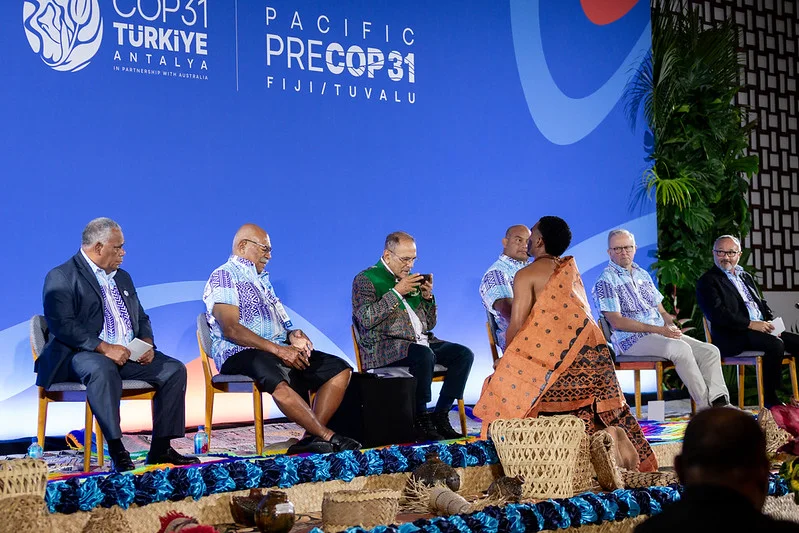 Traditional welcome ceremony at Pre-COP on Oct. 5, 2026. Image: Australia-Pacific Partnership for COP31
Fiji and Tuvalu: Putting Pacific Priorities First (October 5–8)
Before every COP, countries hold a smaller meeting, known as Pre-COP, to share their priorities, test ideas and find common ground before formal talks begin. This year, Fiji, Tuvalu and Australia co-hosted it, bringing delegates from more than 50 countries to Fiji from October 5–8, with a special meeting for world leaders in Tuvalu on October 5–6.
Talks focused on limiting global warming to 1.5°C, helping countries access the funding they need to respond to climate change, keeping promises made under the Paris Agreement and making sure no one is left behind as the world moves to clean energy. For Pacific nations, it was also a chance to show leaders firsthand how climate change is affecting their communities, and the solutions they're already leading. Leaders left with a shared message: the Taku Pakasoa Declaration, Tuvaluan for "strength in unity," which calls on countries to speed up action to keep 1.5°C within reach and puts the ocean and climate finance at the center of the Pacific's priorities for COP31.
Bangkok: Building Confidence in Climate Finance (October 12–18)
Money is one of the biggest questions at every COP. Who pays to help countries cut emissions and adapt to climate change, and how quickly does that funding arrive? At the World Bank and International Monetary Fund's annual meetings in Bangkok, leaders will discuss debt, development finance and investment, all of which will influence countries' ability to deliver on their climate commitments. These meetings sit outside the formal COP process, but real progress here could build trust heading into COP31.
Perth: Turning Commitments Into Power (October 18–20)
Global Citizen NOW brings together leaders who can turn ideas into action, from new policies to investments and partnerships. Just weeks before COP31, Global Citizen NOW: Perth will bring together leaders from government, business, philanthropy, First Nations communities and civil society. Together, they will focus on bringing electricity to more people, speeding up the shift to clean energy and investing in infrastructure built to last.
The Gaps Leaders Need to Close
To meet the goals of the Paris Agreement, the world needs to use more clean electricity to power our homes, transport and industries, and to use energy more efficiently. Today, electricity makes up about 23% of all the energy the world uses. To keep global warming to 1.5°C, the International Renewable Energy Agency says that the share needs to reach 35% by 2035 and more than half by 2050. COP31 organizers have put forward a "35 by 35" pledge, inviting world leaders to commit to that 2035 goal.
Access to electricity is just as urgent. In sub-Saharan Africa, 563 million people still lived without electricity in 2024, which is 86% of everyone in the world without power. Renewable energy, like solar and wind, supplied 18% of the energy the world used in 2023. To meet the 2030 goal, it would need to grow more than four times faster than it has in the past.
Fast progress is possible. Many clean energy technologies are already proven and increasingly affordable. Between 2010 and 2024, Cambodia, Kenya and Rwanda were among the world's fastest-electrifying countries. By 2024, about 99% of people in Cambodia had electricity, along with 77% in Kenya and 72% in Rwanda. Private investment is growing too: in South Africa, Cape Town-based clean energy company Red Rocket has more than 5 gigawatts of wind, solar and hydropower projects running, being built or about to start construction.
Closer to Perth, Western Australia shows what this can look like at scale. In May 2026, 10 new renewable energy and battery projects were approved through a federal government program. Together, they will add nearly 1.9 gigawatts of clean power, enough for about one million homes, plus large batteries to store energy for when it's needed most. The opportunity now is to extend that momentum across the Indo-Pacific, home to some of the world's fastest-growing energy needs.
In Southeast Asia alone, building the cross-border connections for the planned ASEAN Power Grid will require an estimated US$27 billion by 2040, part of more than US$300 billion needed to expand and modernize the region's electricity grids. That's why Global Citizen NOW: Perth is bringing leaders together to mobilize investment and partnerships that can expand clean energy access to 15 million people, add 2 gigawatts of new renewable energy and build responsible supply chains for clean technologies like batteries.
Why October Will Shape Antalya
The building blocks are already here: proven technologies, growing investment and countries showing how fast progress can happen. What's needed now is the funding, partnerships and political commitment to scale them up.
For COP31 to succeed, the promises made in negotiations need to turn into real change on the ground. The work done this October, from Fiji and Tuvalu to Bangkok and Perth, will help set the political, financial and practical conditions for progress in Antalya.