Sudan's civil war, now in its fourth year, has become the world's largest displacement crisis and one of its most severe education emergencies.
Every day, thousands of Sudanese make the difficult choice to flee their homes, pushing the number of displaced to well past 15 million. According to an August 2026 UN report, more than 8 million school-age children are out of school. Many children forced to flee face separation from their families and arrive terrified and hungry.
Beyond the war and the wider humanitarian emergency, education has become an emergency in its own right.
In Darfur, in the west of the country, day-to-day conflict and its compounding effects have left nearly three-quarters of schools damaged, destroyed, or unusable.
Sudan, not to be confused with South Sudan, has endured decades of conflict since independence in 1956, including two prolonged civil wars, the secession of South Sudan in 2011 and the Darfur conflict that began in 2003. The current war erupted on April 15, 2023, when fighting broke out between the Sudanese Armed Forces and the paramilitary Rapid Support Forces, and it has since become the world's largest child displacement crisis.
Many Sudanese have fled across borders, with neighboring Chad and Egypt taking in the largest numbers even as both countries face economic hardship and, in some cases, detain or deport Sudanese refugees. The World Food Programme estimates that Chad now hosts more than 1.3 million Sudanese refugees, the most of any country in Africa per capita, while Egypt hosts roughly 1.4 million refugees.
South Sudan, Ethiopia, and the Central African Republic have also taken in Sudanese nationals displaced by the war as part of a larger regional response.
For Sudanese refugee children and children in host communities, education can be a safeguard against exploitation and conflict itself
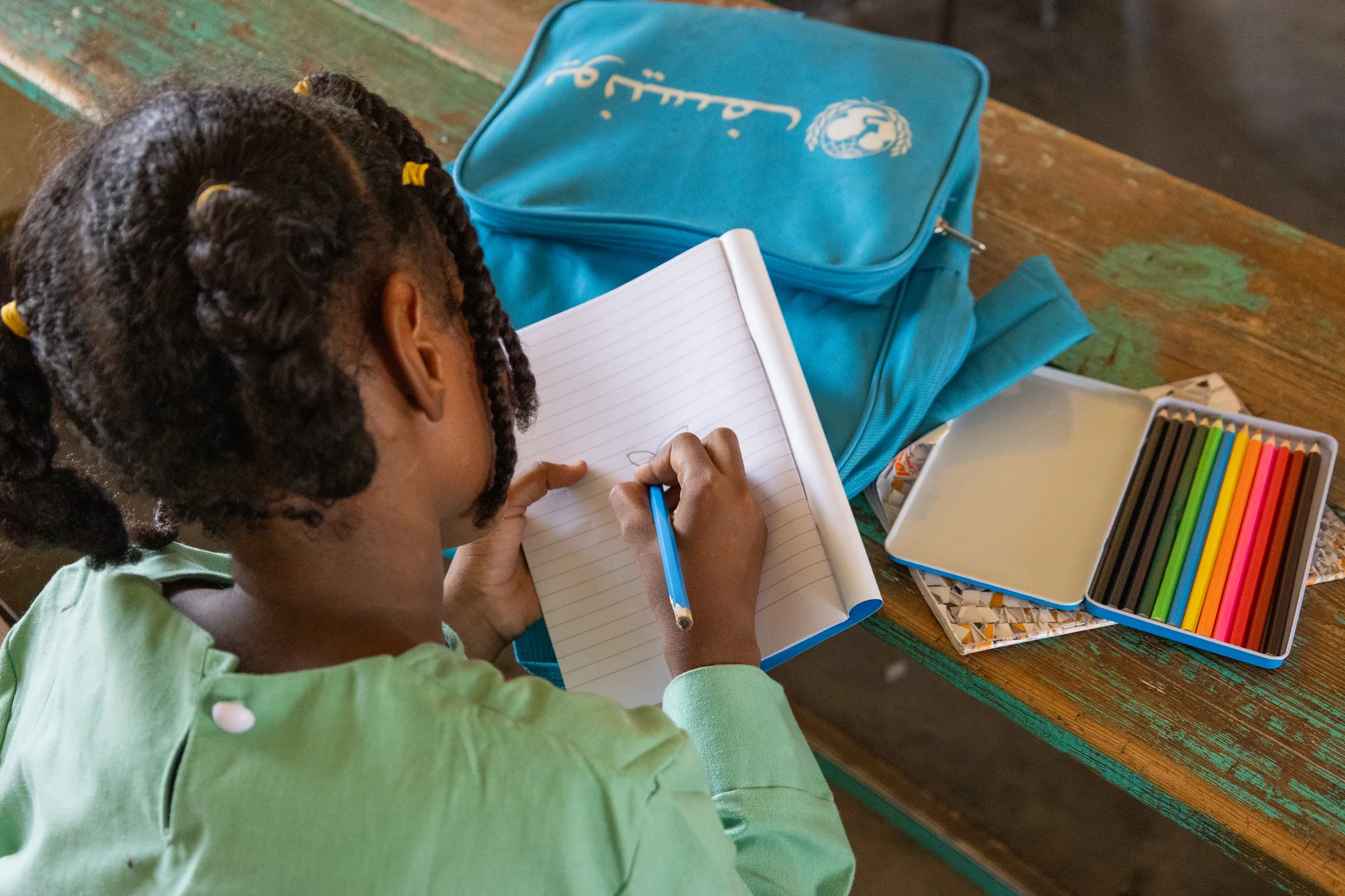 A young girl works in her classroom at Salalab Eastern Basic and Primary School in Port Sudan after fleeing conflict in Sinnar. With support from ECW and UNICEF, she received school supplies and a new uniform to help her continue learning.
According to ECW’s Sudan program, displaced and out-of-school children face heightened exposure to child marriage, early pregnancy, exploitation, abuse and recruitment into armed groups. The longer children remain out of school, the more those risks intensify. In Darfur alone, UNICEF has found that 81% of schools remain closed, 70% of children are not attending class, and nearly 6% of school buildings are being used as shelters.
The daily structure of school, even after a family has fled, can offer a lifeline beyond learning. Often, it is the only routine, adult supervision, and functioning support system left standing. In Ouré-Cassoni refugee camp, in remote northeastern Chad, more than 117,000 refugees are crowded together, with more arriving daily. Food is scarce, and water is rationed to just two liters per person per day. Even here, where families fight daily to meet basic needs amid the trauma of war, reopening schools remains a priority, as much a protection measure as an educational one.
In Al Geneina, Sudan, teachers and parents kept lessons going in damaged classrooms and under trees after conflict devastated local schools. With support from ECW, the Norwegian Refugee Council worked with communities to repair classrooms and provide accelerated learning for children who had fallen behind. After 10 months of classes, more than 2,000 students sat transitional exams in March 2025, a step towards progressing to the next academic level and returning to formal schooling when schools reopen.
Girls also benefit from school in ways that reach well beyond the classroom. It is often where menstrual health support reaches them directly, like through "dignity kits," backpacks or buckets stocked with essentials that help them manage menstruation with dignity. Alongside that support, programs teach girls how to protect themselves against risks such as female genital mutilation, child marriage, and gender-based violence.
In Kiryandongo Refugee Settlement, Uganda, an ECW-funded initiative led by Legal Action Worldwide and SIHA is training out-of-school Sudanese refugee girls in human rights, advocacy, and psychosocial support, preparing them to become community advocates against gender-based violence and for girls' education. What began as a 25-girl pilot in August 2025 has since grown to 175 students, with many choosing to continue into advanced education.
ECW is stepping up to support Sudanese students amid the global funding crisis
ECW has worked in Sudan since 2021, launching an emergency grant that year and, in January 2022, rolling out its first multi-year program with Save the Children and UNICEF, focused on communities in South Kordofan and West Darfur. On the ground, the UN-backed fund and its partners have rebuilt classrooms, hired teachers, and brought students back to learning.
ECW's regional response predates the current funding crisis. Supporting Sudanese refugee children and host communities in Chad, Egypt, Ethiopia, South Sudan, the Central African Republic, Libya and Uganda, an early effort to stabilize Sudan's education system as the war spread across borders.
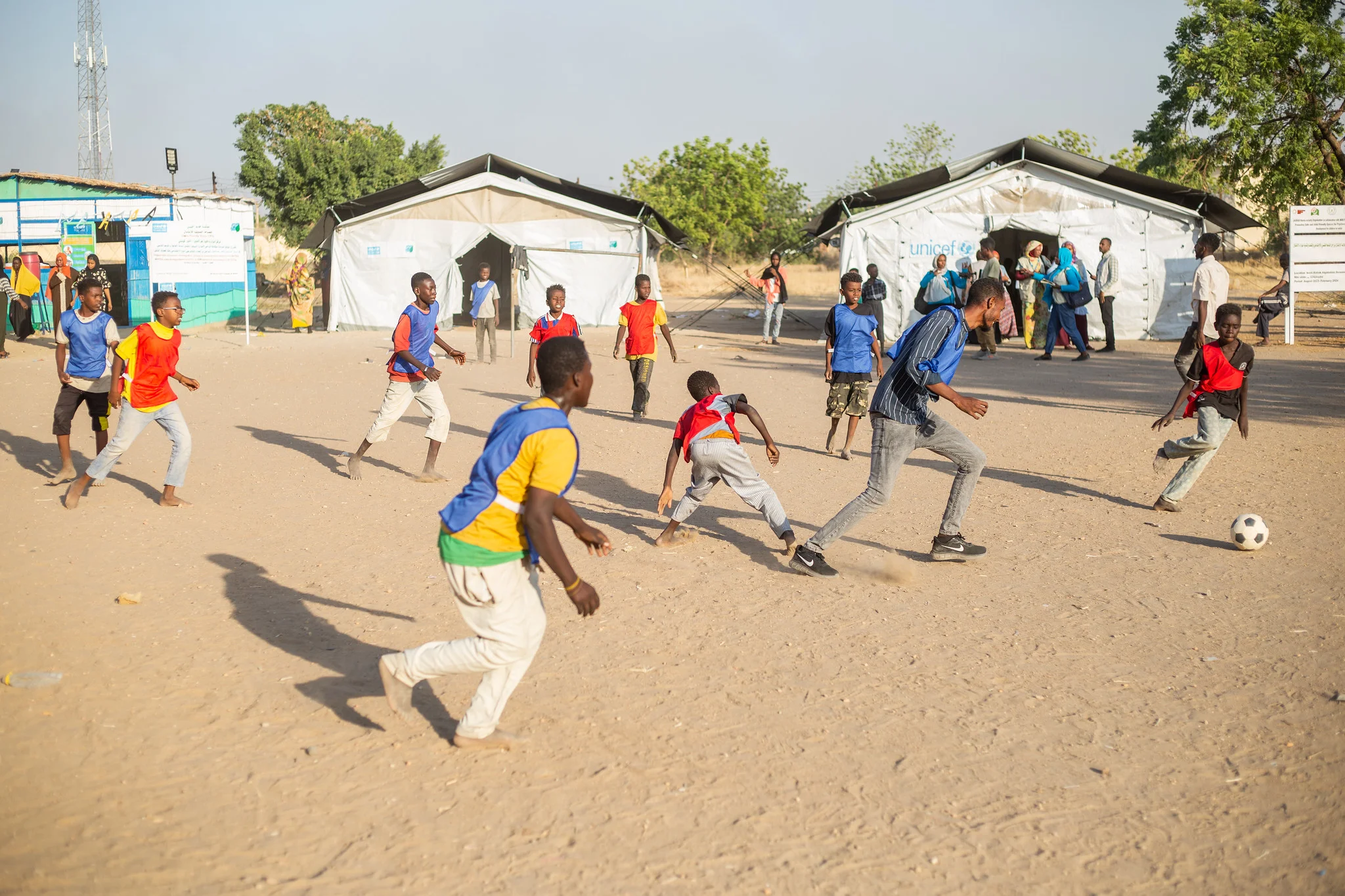 Children play soccer at the UNICEF-supported Makana at El Gox gathering point located in Kosti, White Nile state.
In 2025, when the United States froze and then canceled thousands of USAID contracts worldwide, including critical education support for organizations working in Sudan, ECW stepped up. Until then, the U.S. had been Sudan's single largest humanitarian donor, providing nearly 44% of all humanitarian funding to the country since 2024. The cuts forced UN agencies, international nonprofits, and grassroots emergency response groups to halt or scale back lifesaving programs, including those focused on education and child protection. In August 2026, ECW announced a $22 million lifeline to help 200,000 children return to learning in West Darfur, South Kordofan, and Gedaref.
Conflict continues, and children in Sudan still urgently need education support
More than half of Sudan's teachers have gone unpaid since the war began, yet many keep working anyway. Schools have been attacked and repurposed for military use, and more than 8 million children, nearly half the country's school-age population, have gone roughly 484 days without setting foot in a classroom, one of the longest school closures in the world.
Humanitarian officials warn that without a major funding increase, Sudan risks losing a generation to war for a second time, echoing a warning issued decades ago.
War or no war, every child in Sudan and around the world has a right to an education. Amid the chaos, school offers something nothing else can: routine, contact with trusted adults, and a way to keep growing. Staying enrolled also keeps a temporary disruption from hardening into years of lost learning, a risk that deepens with every month a classroom stays closed. Sudanese children are already finding ways to learn through the war.
Global Citizens can call on governments to fund schools for children in crisis and help ensure ECW and its partners have the resources to keep children learning through conflict, displacement, and disaster. Take action today through the Global Citizen app or on our website.
Editor's Note: This reporting is part of Global Citizen's grant-funded content.