At just 17 years old, Dev Karan is an Indian environmental activist and founder of Pondora — a community focused initiative working to save India’s ponds from pollution. Large parts of India’s water sources are heavily polluted, including the River Ganges which is relied on by over 400 million people. Karan’s work fostering community stewardship of vulnerable water sources has earned him recognition as a Young Activist Summit laureate for 2025. With civic space considered repressed in India, and environmental protection and water justice relegated to one-off community clean-ups that serve as photo ops, Karan shares how he managed to mobilise communities to protect vital water sources.
My name is Dev Karan.
I’m a high schooler who loves the environment, football, films, and reading books. Though a lot of my weekends I am unable to pursue any one of these activities. I end up near a pond, not the kind you see in travel photos, but the kind most people stop noticing. The ones behind fields, near bus stands, between houses. The ones that are supposed to hold water, recharge groundwater, cool the village, support biodiversity.
The ones that are quietly dying.
I did not start out thinking of myself as an “activist.” That word can feel big. My work started with a feeling that was very simple: I saw something wrong, and I could not unsee it. I’m someone who doesn’t feel satisfied by “awareness.” I want systems that keep working.

Water justice and youth power are two things that matter most to me.
Water justice, because water decides everything. In India [and across the globe], water is not just the environment, it is health, livelihood, dignity, and survival. When a local pond dies, the first people to feel it are not the ones in air-conditioned rooms. It is the farmers, women who manage household water, children, and families who have no backup plan.
Youth power matters because I’ve seen what happens when young people are only used for slogans. “The youth are the future” sounds nice, but it can also become a way to delay responsibility. I believe young people should be trusted with real work now, because we live inside this crisis now.
That belief is what shaped Pondora.
A couple of years ago, I saw a village pond that barely looked like a pond anymore.
The water had turned a strange colour, thick with waste and plastic. It felt like someone had taken something living and turned it into a dumping ground.
That was the first time climate change stopped being a distant topic for me. It became local. Physical. Embarrassingly close. And I remember thinking, if this is what a pond looks like in one village, how many more are like this across India, and why do we accept it as normal?
I started reading, speaking to people, and looking at government schemes. India has had major efforts to restore water bodies, and that matters. But I kept seeing the same pattern: a pond gets cleaned, it looks better for a while, photos are taken, and then it slowly slips back. Not always because the engineering failed, but because the maintenance disappeared.
That gap bothered me more than the pollution itself. It meant we were doing the hard part and then leaving the job unfinished.
The experience of activism has been a mix of hope and hard reality; learning to listen before leading, and learning that real work is slow, practical, and often unglamorous.
The moment you ask, “Who will still maintain this in six months?” you’re no longer doing feel-good work; you’re asking for accountability.
Pondora started in 2024, and is built on one simple principle: restoration without stewardship does not last.
A few of us were still in school, but we were not okay with the idea that the best we could do was a one-day clean-up. We wanted a model where a pond stays alive because a community stays involved. So we formed our work in two parts.
The first part is community. We start with baseline surveys to understand how people use the pond and what they believe about it. We work with schools to train students as ‘Pond Ambassadors’, not just to run awareness drives, but to learn how to monitor water health and talk to their own community with confidence. We also help form pond committees under the Village Council structure, so responsibility does not sit with a few volunteers who might leave, but with local systems that are meant to last.
The second part is technology, but only the kind that works on the ground. We built a smart pond maintenance kit that combines electronic sensors with simple chemical test strips. The sensors measure things like temperature, pH, and total dissolved solids. The strips help check specific contaminants. We connect it to a phone so readings can be captured and logged. The point is not fancy innovation. The point is transparency. When data is visible and consistent, it becomes harder for a pond to be ignored.
In Bambawar, we have already reached close to 100 people, selected 35 Pond Ambassadors for training, and we aim to work across seven pond locations in the village. We’ve also worked in Abupur with mineral water brand Bisleri’s social responsibility team, to train local students on monitoring and maintenance.
In real life, the work looks like sitting with villagers and listening before speaking, running sessions in schools, walking around a pond with students holding test strips like it is normal, and slowly turning “someone should do something” into “we are doing something.”
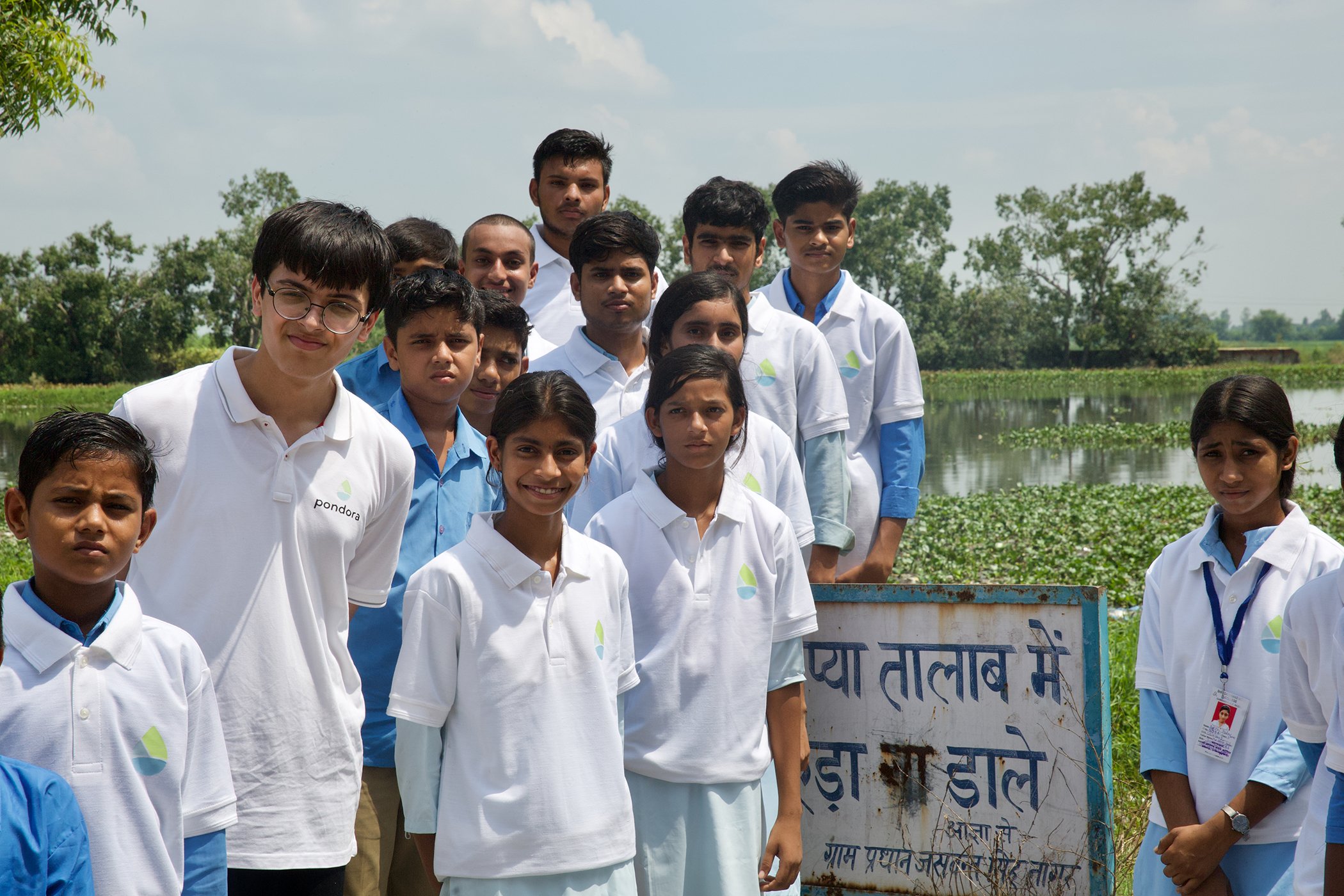 Dev Karan is pictured here while taking part in activities for Pondora, the community focused initiative he founded to save India’s ponds from pollution.
Environmental work sounds “safe” until it touches real interests…
…land, dumping, contracts, and local power.
With ponds, the deeper challenge is the tragedy of the commons — everyone benefits, so responsibility gets passed around until neglect becomes normal. The moment you ask, “Who will still maintain this in six months?” you’re no longer doing feel-good work; you’re asking for accountability.
In that process, local governance has actually mattered a lot. Village councils and local leaders have extended support when the work is respectful, transparent, and rooted in the community’s priorities. When we involve them early, share the baseline findings, and build a clear maintenance system through pond committees and youth ambassadors, the work becomes easier to sustain because it isn’t “outsiders fixing a pond” — it’s the village protecting its own asset.
The real pressure I’ve felt isn’t dramatic repression, it’s apathy and ignorance, the slow resistance that comes when change threatens comfort, routines, or informal arrangements. As a young person, I also have to earn seriousness. People sometimes assume it’s for awards, or that someone else is “behind” it. Trust is built the long way; by showing up again and again, doing the unglamorous work, and strengthening local systems instead of trying to replace them.
We’ve faced skepticism, hesitation, and quiet pushback, the kind that tries to delay things until you lose energy. Our response has been simple: keep it local, keep it transparent, listen first, and let consistent work and shared ownership speak louder than our opinions.
The Young Activist Summit recognition is a responsibility.
It told me that a solution built from the ground up can still be seen globally.
It also expanded my circle. Meeting other laureates and young leaders reminded me that the world has no shortage of problems, but it also has no shortage of people trying to solve them with real effort.
Most importantly, it gave Pondora visibility that can translate into stronger partnerships. The recognition mattered because it validated the very specific idea that small, local solutions deserve to be taken seriously if they are built to last. Pondora was described as a replicable model for water ecosystem restoration, one pond at a time. We are not pretending we will save the planet overnight. We are trying to protect what is right in front of us, and build a method others can repeat.
"The youth are the future” sounds nice, but it can also become a way to delay responsibility.
If I could ask for tangible reforms in India, I would start with integrity and accountability.
I want a committed effort from those in power to recognise environmental harm as an emergency. This matters because short-term incentives quietly destroy ecosystems even when policies look good on paper.
Second, I want ponds treated like real climate infrastructure, not as leftover land. That means updated public pond records, strict action against encroachment, and clear responsibility for long-term maintenance.
Third, I want funding structures that reward maintenance, not just clean-up. A pond does not stay alive because it looked good for one month. It stays alive because someone is responsible in month six, month twelve, year three.
And finally, I want citizen-led monitoring to become normal. When communities can track water health and see the changes over time, environmental protection becomes harder to manipulate and easier to defend.
I am still a student. I’m still learning. But I know this much: change does not happen because someone writes a good speech. It happens when people organise, learn, and protect what they depend on.
For me, that begins with a pond.
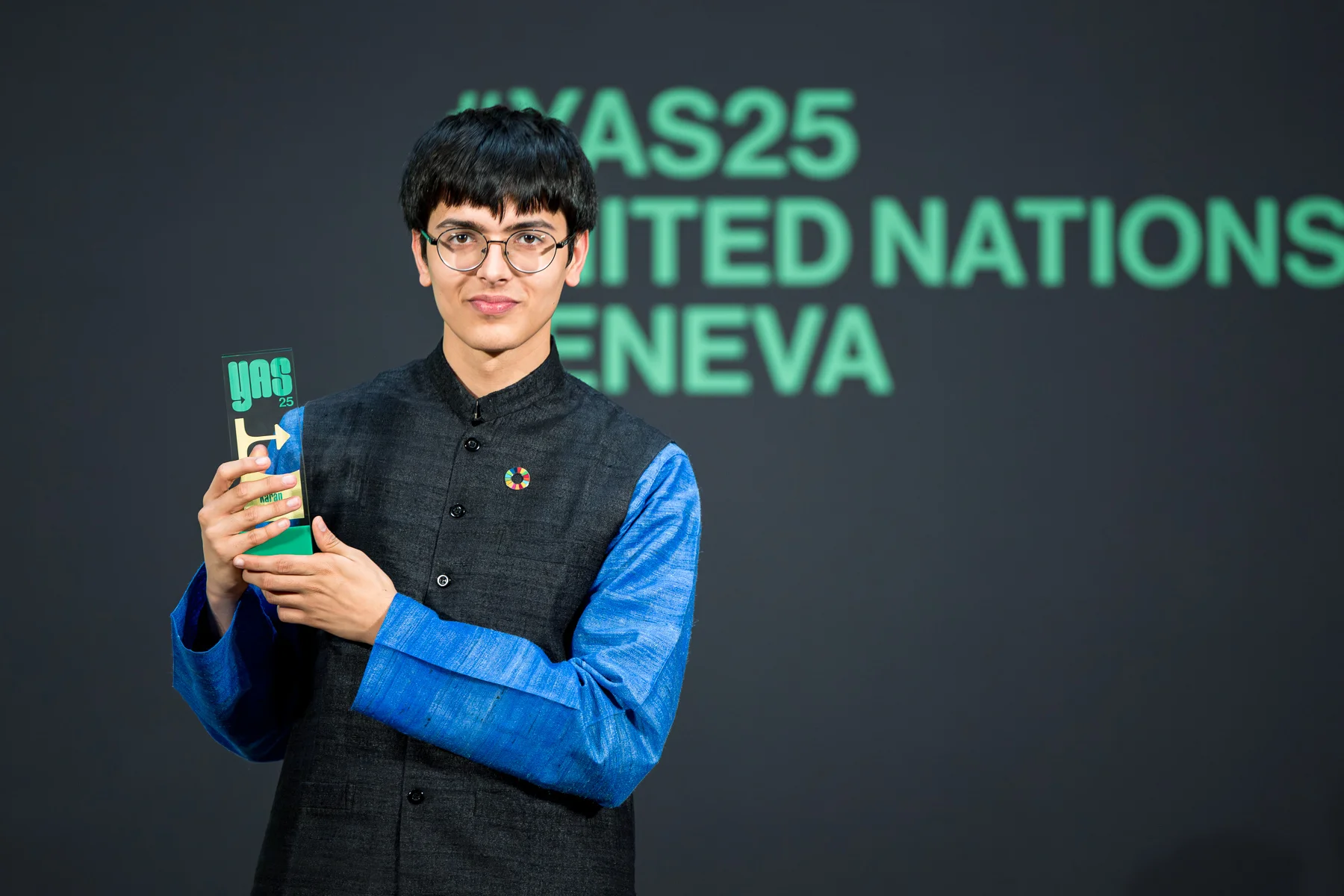 Dev Karan’s work fostering community stewardship of vulnerable water sources has earned him recognition as a Young Activist Summit laureate for 2025.
This article, as narrated to Gugulethu Mhlungu, has been slightly edited for clarity.
The 2025-2026 In My Own Words series is part of Global Citizen’s grant-funded content.