Climate-related costs are skyrocketing as countries face more frequent disasters and rising temperatures, but the burden isn’t distributed evenly.
For years, many low-polluting countries have stressed that they face some of the steepest consequences of climate change despite contributing only a fraction of historical global emissions. Rebuilding after extreme weather events and upgrading infrastructure often forces governments to take out loans at steep rates, deepening debt and limiting public spending on health, education, and, ultimately, poverty reduction.
This imbalance dominated the conversation at COP30 last month. Against this backdrop, France arrived in Belém with the chance to prove whether its recent push for a fairer climate finance system would translate into actual progress when push comes to shove.
How France Showed Up in Belém
France has spent the past two years calling for a fairer way to share those costs. At the Summit for a New Global Financial Pact in Paris, President Emmanuel Macron called for greater solidarity with the Global South by pushing for redesigned financial institutions so that no country has to choose between fighting poverty or climate change.
COP30, then, was a test of whether that ambition could translate into real action.
An early signal came when France backed the Tropical Forests Forever Facility (TFFF), a Brazil-led initiative that rewards countries for protecting forests rather than cutting them down. At its launch, TFFF won support from 53 countries and secured more than US$5.5 billion in initial commitments. At least 20% of that funding is earmarked for Indigenous peoples and local communities who are essential in protecting tropical forests.
TFFF’s successful launch landed after months of growing political urgency for forest protection. At Global Citizen Festival Amazonia, French Minister Delegate Éléonore Caroit reaffirmed France’s support for safeguarding major rainforest regions around the world, including the Amazon, the Congo Basin, and Southeast Asian forests. “Together, we reaffirm France’s dedication to supporting the rainforest, advancing sustainable development, and fostering global solidarity,” Caroit said in a video statement played on stage.
In her remarks, Caroit also reported that France is on track to meet the pledge it made at COP28 to invest €500 million in forests by 2030, offering this commitment as a concrete example of its wider climate leadership.
These announcements increased attention ahead of Belém, and further detail on how France’s commitments align and the anticipated timelines for initiatives such as TFFF would help stakeholders track progress. With no specific milestones laid out before the end of the decade, questions linger about how much money will actually reach communities on the ground. In French Guiana, for instance, Indigenous and local communities face critical deforestation and land-rights challenges that show just how difficult it can be to convert global pledges into progress. In other words, the challenge for France now lies not in simply making a pledge but in defining its timing and rollout.
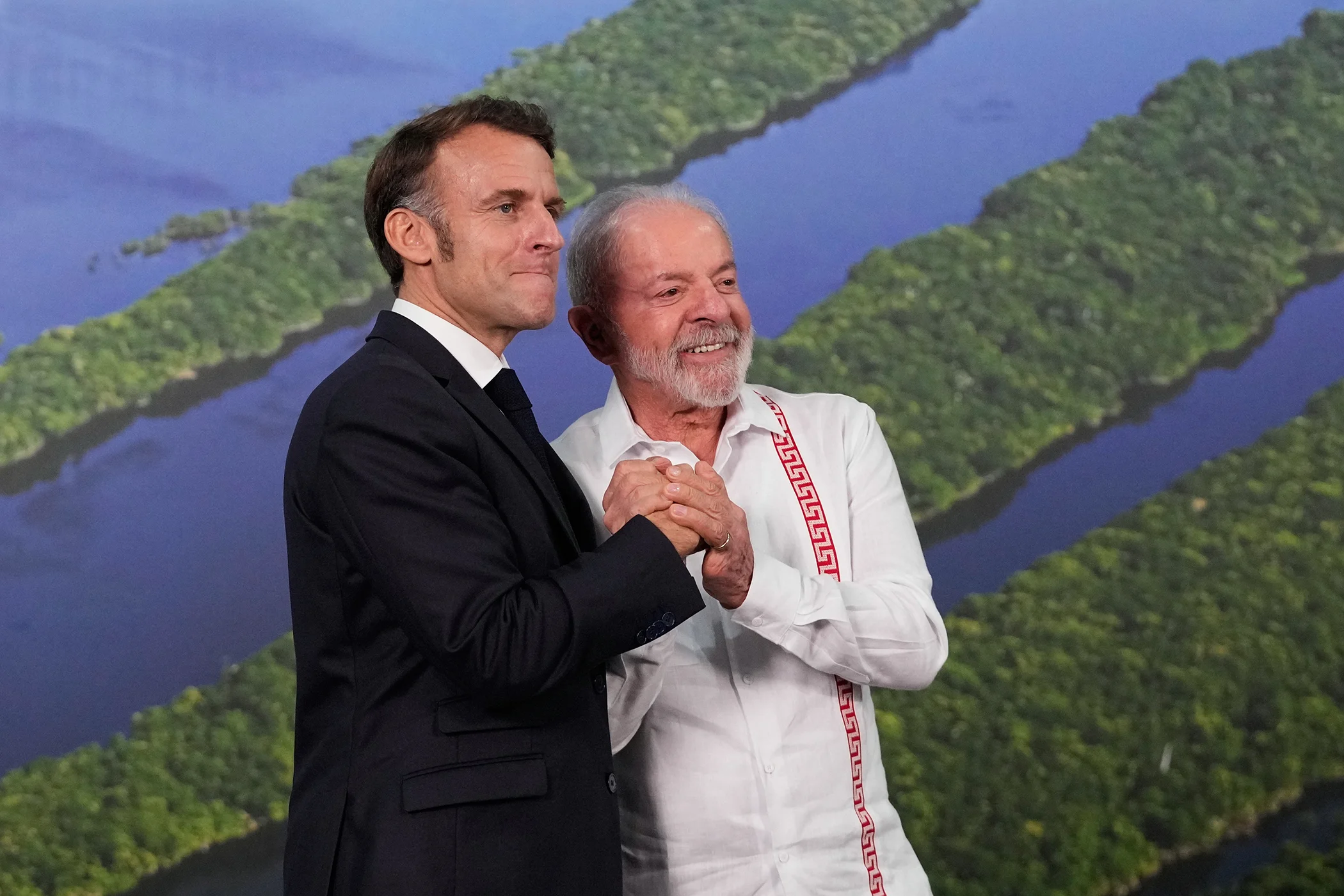 Brazil's President Luiz Inacio Lula da Silva, right, and France President Emmanuel Macron shake hands during the COP30 U.N. Climate Summit, in Belem, Brazil, Nov. 6, 2025.
France’s Role in Global Climate Finance
A second challenge is predictability. Climate-vulnerable countries need reliable, grant-based support, not new debt or vague timelines.
And the need for reliable, debt-free climate finance is greater than ever. Currently, countries are busy negotiating the next global climate finance goal as part of the “Baku to Belém” roadmap. This includes nailing down how to reach a target of at least US$300 billion in public finance alone and a broader goal of US$1.3 trillion annually in blended public-private finance by 2035.
France has an important role to play in reaching this goal. In 2023, France allocated €7.2 billion in climate finance, with €2.8 billion specifically set aside for climate adaptation. On paper, this ranks the country among the world’s top climate contributors. However, much of this support comes in the form of loans, adding to countries’ debt burdens on top of climate shocks. So far, France has yet to release a clear finance plan or specify what portion of its future support will be in grants or loans. Without a clear structure, implementation may be uneven across countries with different fiscal capacities.
The push for predictable, grant-based support raises larger questions about where new resources will come from. The French government has tried to answer that partly through a mechanism known as solidarity levies.
Levies are taxes on high-emitting activities and industries, like airline travel, that create new, debt-free funding for the overall social good, like climate and development investments. France introduced this concept in 2006 with its airline solidarity tax, also known as the “Chirac tax.” The approach has since generated steady revenue for health and development initiatives and inspired similar models in other countries.
Solidarity Levies Championed Abroad, Controversial at Home
In recent years, France has focused on building international coalitions to encourage others to implement similar levies beyond its borders. At COP30, it helped expand the Global Solidarity Levies Task Force and strengthen the Premium Flyers Solidarity Coalition. Both of these initiatives aim to expand countries and sectors that are coordinating levy-based financing. Many negotiators framed these levies as tools based on fairness that oblige higher-emitting activities to support the climate-vulnerable communities they impact.
But domestically, the situation is complex. Last month, the French Transport Ministry stated that France had “no intention of raising the solidarity tax further,” even as France continues to champion the approach abroad. In its 2025 budget, the government removed the automatic earmarking that directed tax revenues toward development and climate programs. Civil society groups have warned that without earmarking, these funds risk flowing into the general budget rather than international climate commitments, as originally intended. These changes at home weaken a tax that France itself often promotes as a model for fair and predictable climate finance. If the goal is to promote solidarity levies as a just solution, domestic policy needs to match its international marketing.
What France Needs to Do Next
COP30 showed that France has the goods to bolster environmental efforts, from forest protection to innovative financing. But delivering on these commitments requires transparency and follow-through.
To review, France has yet to:
- Publish a clear timeline and tracking deadlines for its €500 million TFFF contribution;
- Define a trajectory for its post-2025 climate finance plans, committing to grant-based support for adaptation and loss and damage;
- Align domestic aviation tax policy and earmarking rules with its international advocacy on solidarity levies;
Develop a comprehensive, long-term forest protection strategy that codifies Indigenous leadership and land rights, including in its overseas territories.
What Global Citizens Can Do
France helped set the agenda in Belém. But words alone aren’t enough. Now it must match ambition with action.
You can do your part and help by:
- Calling on French lawmakers to restore the airline solidarity tax and reinstate clear earmarking for climate and development funds;
- Urging France to increase grants in its climate finance and publish a clear, ambitious post-2025 plan;
- Supporting campaigns such as Protect the Amazon (PTA) to put money directly in the hands of Indigenous peoples and local communities protecting forests, and monitor how new funds like TFFF are implemented.
It’s time for France to meet its ambitious standards and become the global climate leader the world needs today.